Example
Johnny Reyes
Denver, Colorado · Born June 4, 2002
This is what $99 looks like. Open each thing, then tell us who should receive yours.
What you receive
Three files. That is the package.
01
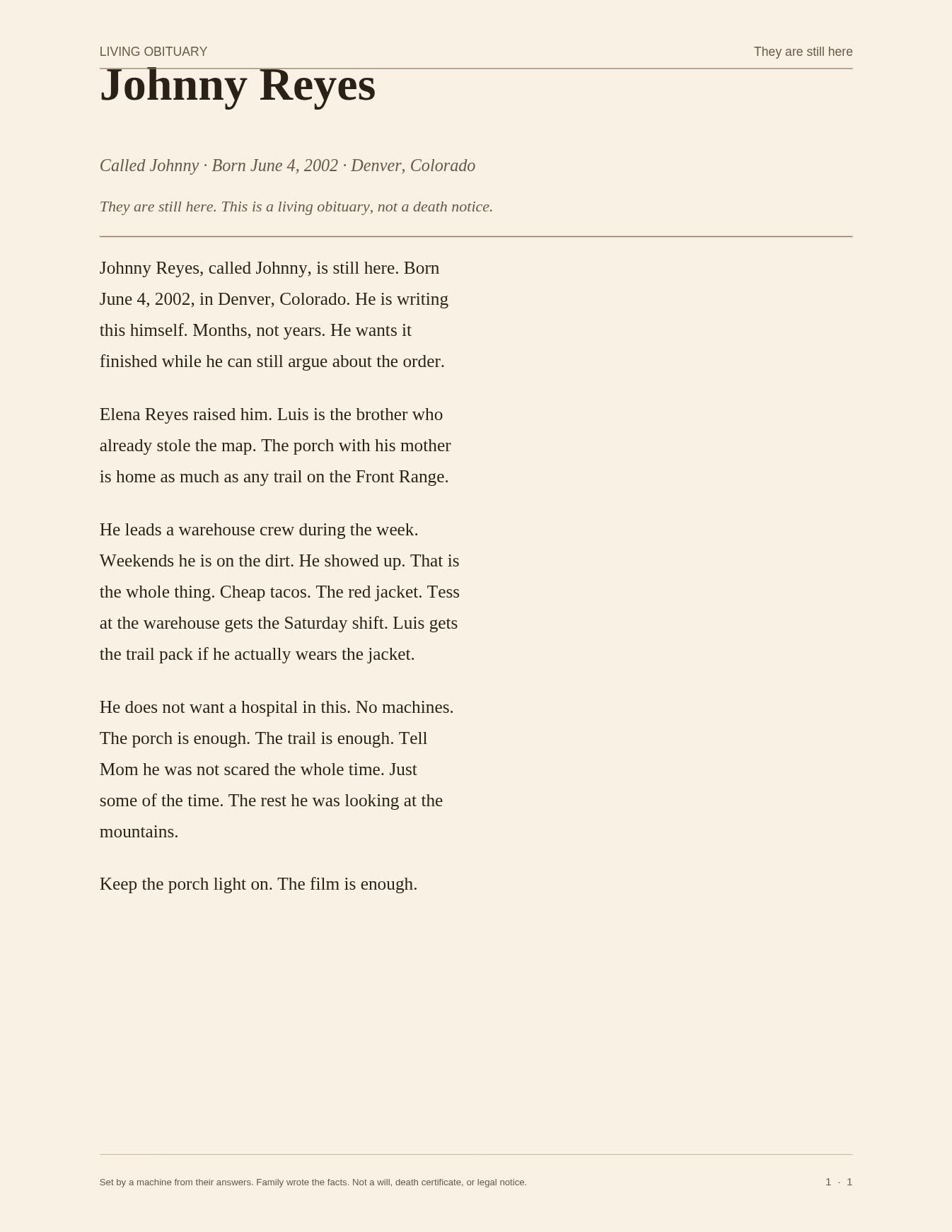
Traditional newspaper obituary
A PDF to print, and a Word document you can edit. Use it however you want — including the local paper.
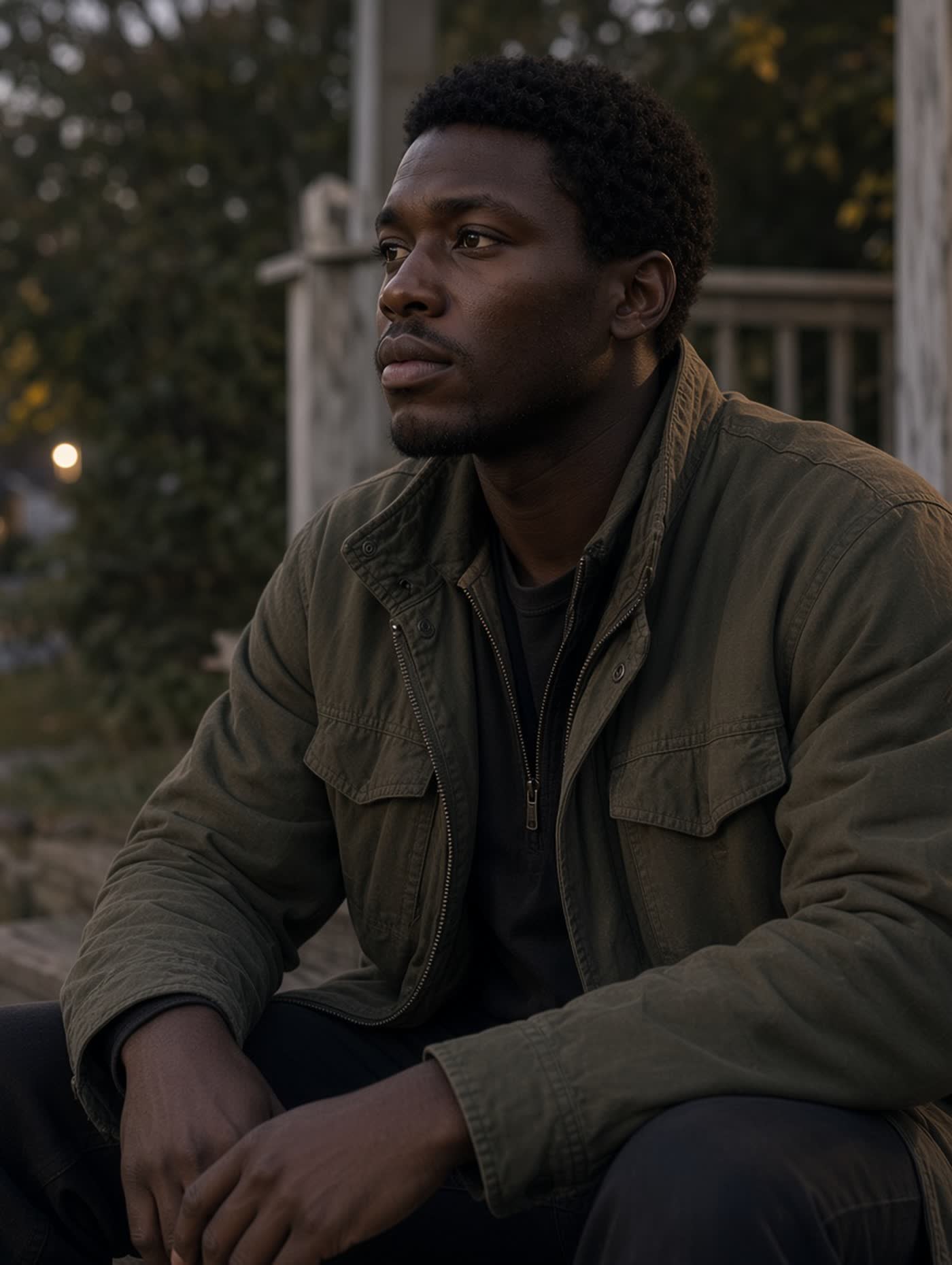
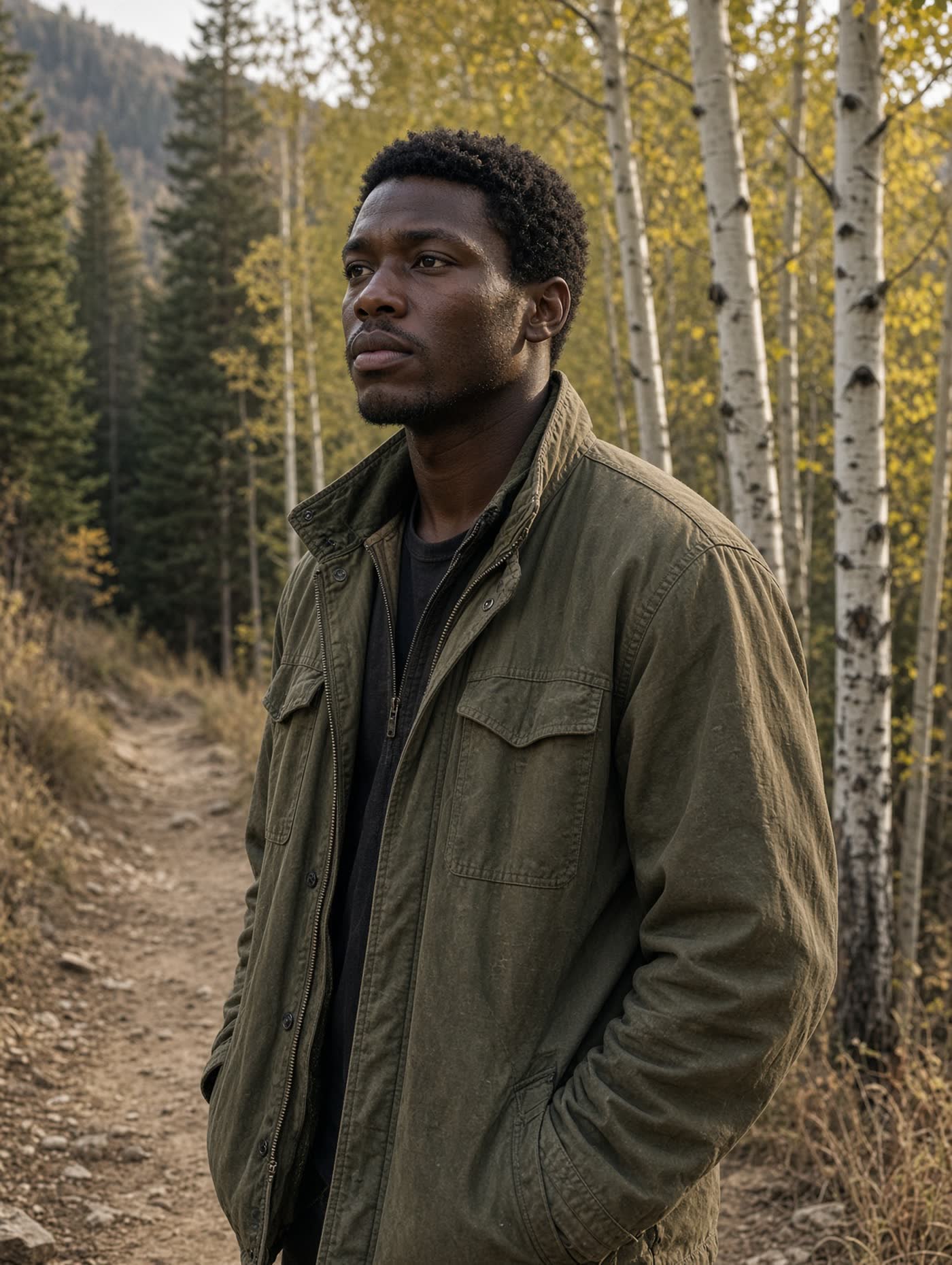
Look at each one
The page, the photo pages, and the film.
Every question. Every answer.
Johnny answered 31 of 78. The full list they answered, with the answers — a keepsake from these days. Skipped ones stay out. The newspaper page is made from these.
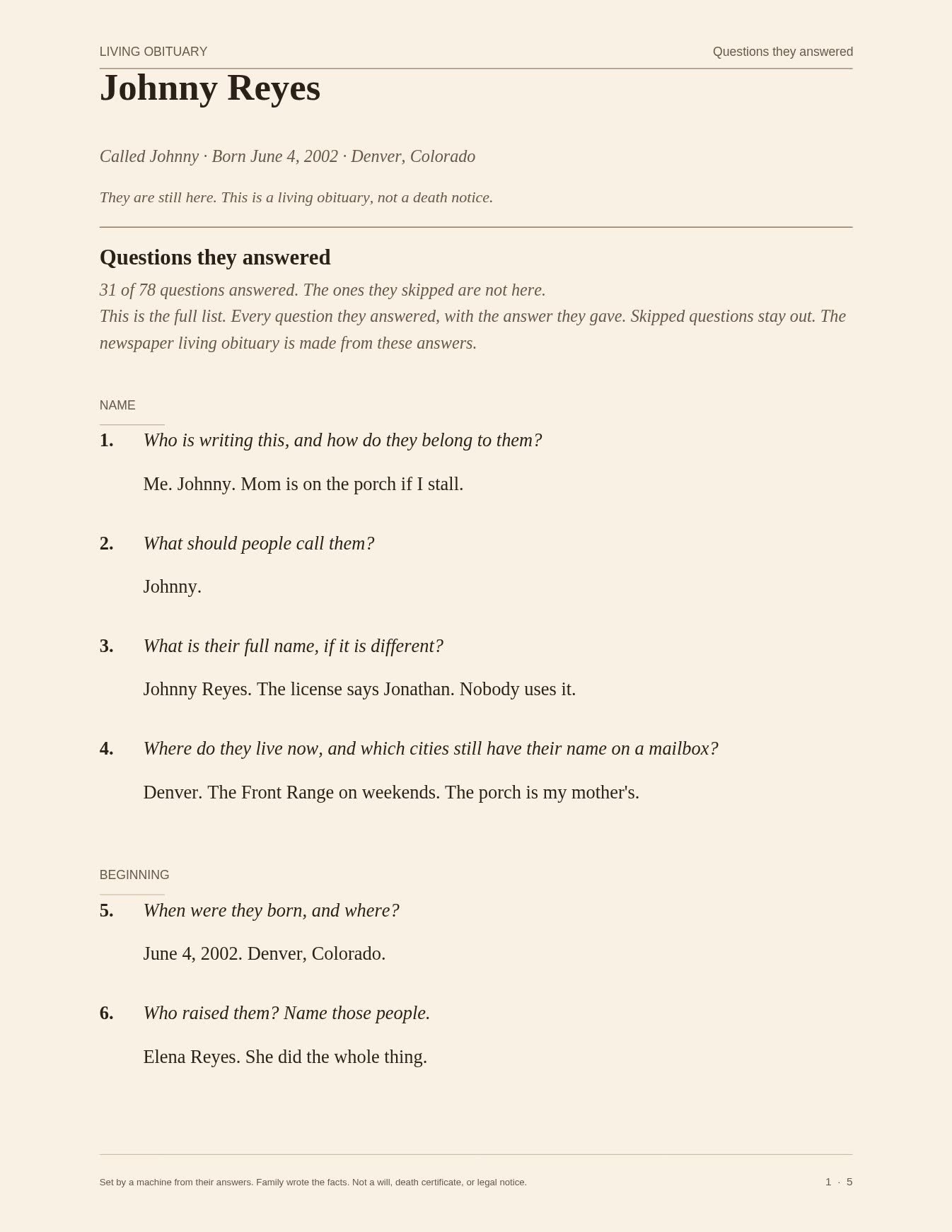
Click to open the full question-and-answer PDF.
Open the newspaper obituary to see how these answers read as a newspaper page.
Name
Your name, and how you know them
Write your name. Then say if you are their daughter, son, spouse, parent, or friend. If they are writing it themselves, say so.
Me. Johnny. Mom is on the porch if I stall.
What should people call them?
The name on the story. A nickname is fine. Write it the way family says it out loud.
Johnny.
What is their full name, if it is different?
First, middle, last. Spell it. This is the line a newspaper would print in the first sentence.
Johnny Reyes. The license says Jonathan. Nobody uses it.
Where do they live now, and which cities still have their name on a mailbox?
The town they wake up in, and the ones they never really left. City and state. Do not write a house number or a street of a living person — that is how thieves work. A newspaper prints the city.
Denver. The Front Range on weekends. The porch is my mother's.
Beginning
When were they born, and where?
The date if you have it, and the town. A year is enough if the day is gone, or if they do not want the full date in print. A newspaper uses this for the first sentence.
June 4, 2002. Denver, Colorado.
Who raised them? Name those people.
Mother, father, a grandmother, an aunt, the ones who did the raising. Write the names, not the roles only.
Elena Reyes. She did the whole thing.
What were their parents' names — including a mother's name before she married, if you have it?
Newspapers ask this every time so the story can name their people. Their mother's name before she married. Skip if you do not have it. Do not add maiden names of living people who are not them.
Elena Reyes. Put her first.
Where did they grow up, and what did that place feel like?
The town, the house, the street, the kitchen. Was it loud? Small? A porch. A child can answer this.
Denver. A small house. The porch light. Mountains if you looked west.
Who did they grow up with — sisters, brothers, cousins in the same house?
Name the children in that house. The one they shared a room with. Skip if they grew up alone.
Luis. He is younger. He already stole the map.
School and work
What work did they do, or how did they spend their days?
A job, a farm, a classroom, the work of a house, the work of being here. What would they say if you asked at dinner.
Warehouse lead during the week. Trails on the weekend. I showed up.
What were they known for at work — the thing a coworker would say without thinking?
On time. The one who brought extra. The one who stayed. A nickname from the floor. Skip if they never had that kind of work.
He showed up. Tess will say that. The Saturday shift is hers now.
Love
Who do they love?
Write the names. People first. Animals if they count. This is the list a newspaper would get wrong if you rush it.
Mom. Luis. Tess at the warehouse. The people who still show up.
Who else belongs — sisters, brothers, people they chose as family?
The ones who would be hurt if they were left off. In-laws they kept. A friend who became a sister. Name them.
Luis. Tess. That is the list.
Is there a friend so close the story is wrong without them?
The one they called first. The one who still has a key. Skip if family is the whole of it.
Luis on the trail. Tess at work. Mom on the porch.
Texture
What did they love to do when nobody was watching?
The garden, the kitchen, the trail, a tool, a book, a game, the chair and the window. Private joy is the true one.
Walk. Cheap tacos after. Not talking.
What food, music, team, or place would make a stranger know it was them?
Biscuits. A hymn. A ball club. A porch. A radio station. Be specific enough that family laughs.
Cheap tacos. The dirt trail. The red jacket.
What did they wear that was them — a hat, a jacket, a ring, a color?
The thing in a photograph you would know from the back of a room. Skip if clothes were never the point.
The red jacket. Luis can have it if he actually wears it.
Is there a place they want people to picture them — a chair, a garden, a trail, a kitchen?
Not a cemetery. The room they were most themselves in. Where the light was.
The trail at late light. Or the porch with Mom. Not a clinic.
Who they were
If I sat next to them for an afternoon, what would I notice first?
Voice. Hands. How close they sat. Whether they offered food before they offered talk. The first true thing.
I do not make it complicated. I look at the mountains.
How did they show love without saying the word?
A ride. A plate left in the oven. A letter. Showing up early. Fixing the thing you had not asked about yet.
Showing up. The porch talks. I did not disappear.
What were they like in a hard week — quiet, joking, busy, still?
Not the pretty version. The true one. This is the person family actually lived with.
Quiet. Then joking. I was not scared the whole time. Just some of the time.
Pictures
What photographs belong in the ten-minute film?
About forty pictures makes ten minutes. Name the days, not every file. Garden, classroom, wedding, porch, the ordinary Tuesday. Only photographs family has the right to share.
The trail. The porch with Mom. Friends who still show up. No hospital. No machines.
What should we leave out of the pictures?
A hospital room. A person. A time they do not want shown. Be plain. We will obey this.
No hospital. No machines. The porch is enough. The trail is enough.
The story
What should people remember?
The true thing, not the pretty thing, if those are different. This is the sentence under their name.
I showed up. Keep the porch light on. Tell Mom I was not scared on the trail.
What do they want the people who love them to know, while they can still say it?
Said now, while they are here. Not a speech. A few lines is enough. This is not last words. It is living.
I have six months, maybe more. I want the film finished while I can still argue about the order.
Is there one sentence they want in the written story?
The line that has to be in it, in their words. We will not rewrite this line.
The film is enough.
If this story had to fit in four lines in a newspaper, what could not be cut?
Name. Who they loved. What they did. The one true thing. Pretend ink is expensive.
Johnny Reyes. Twenty-four. Elena's son. The trail. He is still here.
What should this story not say?
A marriage. An illness. A name. A cause of anything. Never a Social Security number, a bank number, or a house number. The thing family would be angry to see in print. Skip if nothing is off limits.
Do not put a clinic in it. Do not put a street number.
What should Mom keep from the porch talks?
A few sentences is enough. Names help. Skip if this does not fit.
That I was not scared the whole time. Just some of the time. The rest I was looking at the mountains.
Who gets the trail pack?
A few sentences is enough. Names help. Skip if this does not fit.
Luis. He already stole the map anyway. Tell him the red jacket is his if he actually wears it.
Who should we call first?
A few sentences is enough. Names help. Skip if this does not fit.
Tess at the warehouse. Tell her the Saturday shift is hers. Then Luis. Then nobody else unless they already knew.